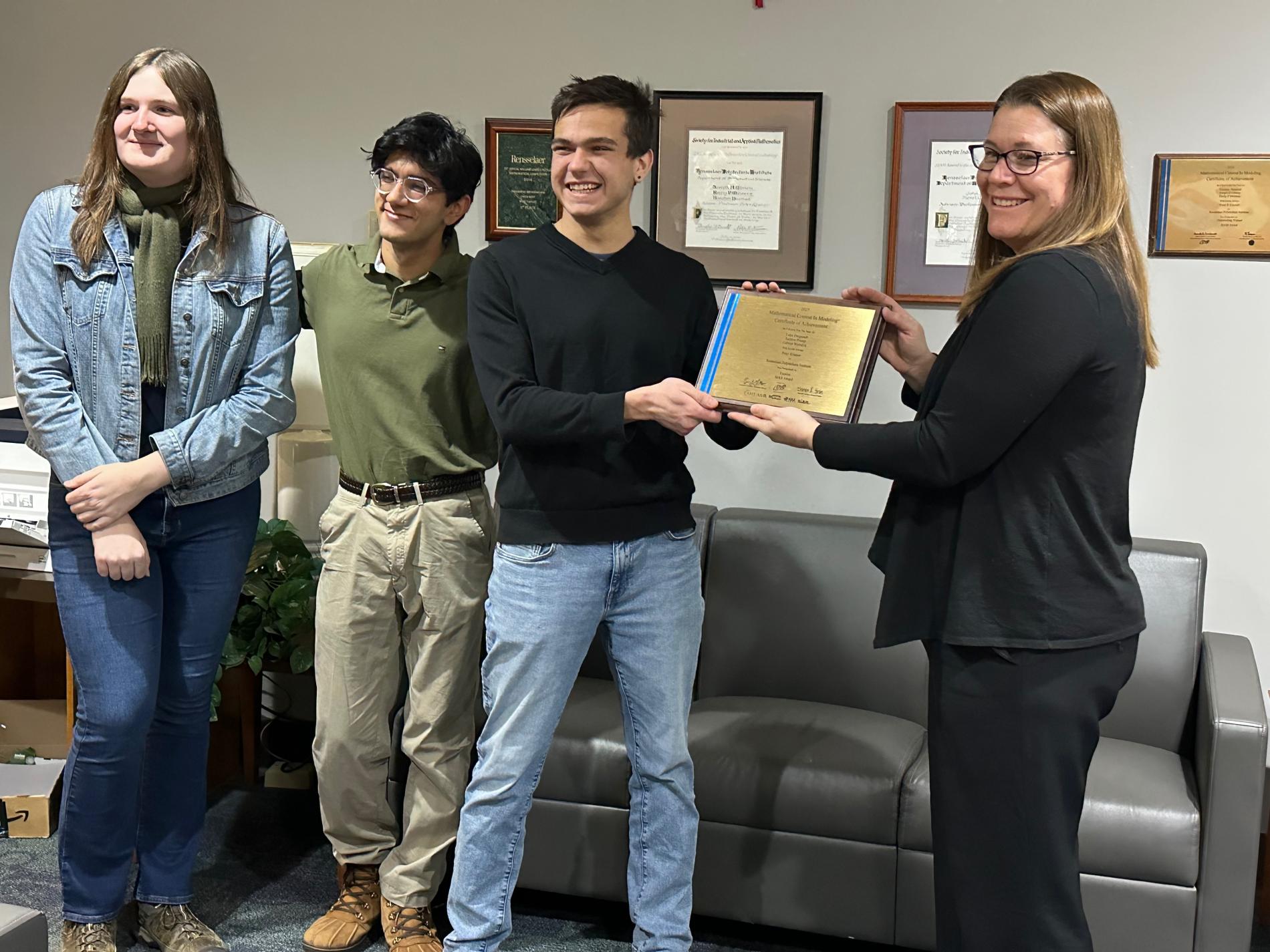
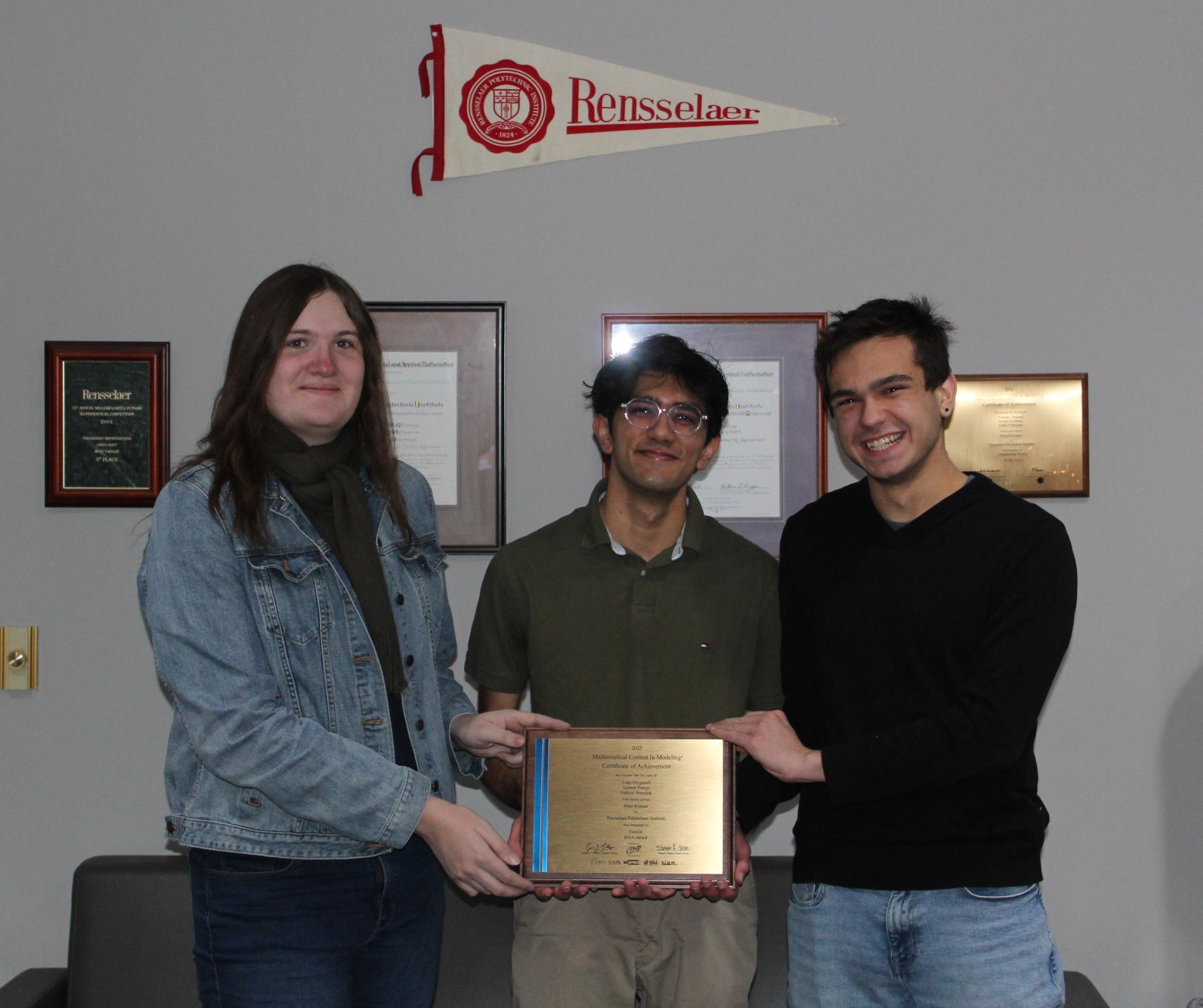
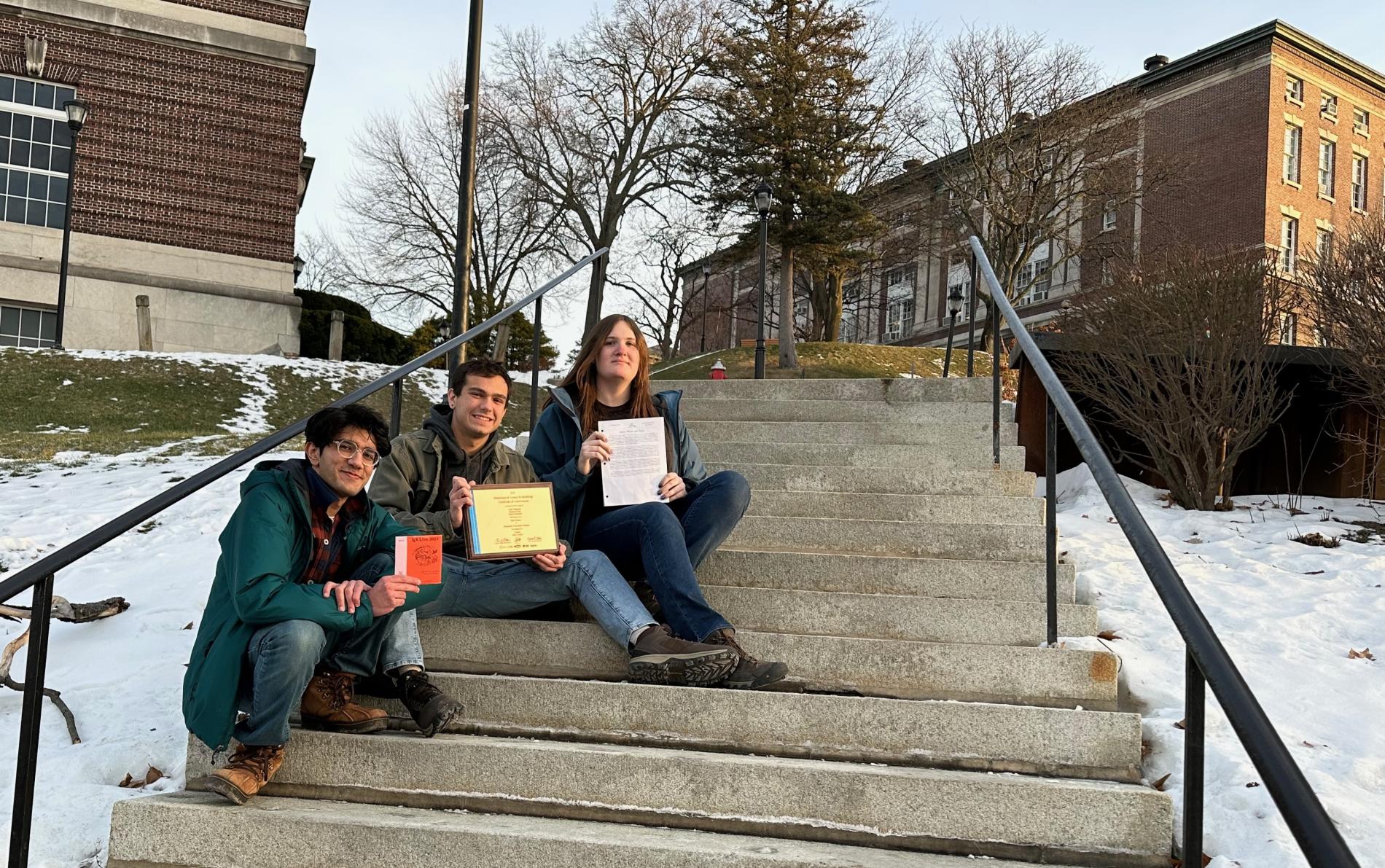
The team of Luke Daignault (physics/math), Sameer Premji (math), and Gabriel Weredyk (math) won the MAA (Mathematical Association of America) award in 2025 in the Mathematical and Interdisciplinary Contest in Modeling. Their winning paper addressed an archaeologist's inverse problem of how to ascertain, from non-destructive observations of a historical staircase, how and when the staircase was constructed and how it was used. The MAA selected their paper out of 2082 international submissions for their unique award on this problem.
The team’s creative model consisted of coupled partial differential equations for the temporal evolution of the distribution of stair usage and damage to stairs by traffic, spontaneous cracks, and vegetation. They simulated their model numerically to determine signatures of usage patterns, stair material, and environmental effects. The forward simulations were analyzed to provide a concise classification scheme for interpreting historical stair usage based on current observations
Amanda Beecher from the Consortium for Mathematics and Its Applications, the organization behind the Mathematical and Interdisciplinary Contest in Modeling, visited RPI in December to present the award plaque to the winning team. Luke, Gabriel, and Sameer are the latest team from RPI to achieve extraordinary success in this competition designed to challenge undergraduate students to work as a team to solve a real-world problem by thinking up a mathematical modeling framework and using analytical and computational techniques they have learned in classes. Two RPI teams won the MAA Award on different problems in the 2021 competition, and RPI teams were recognized with other top named awards in 2005, 2010, and 2016. The students on these winning teams have, as in 2025, generally been collaborations between students majoring in mathematics and physics.